Project Updates & Impacts
Traffic Impacts
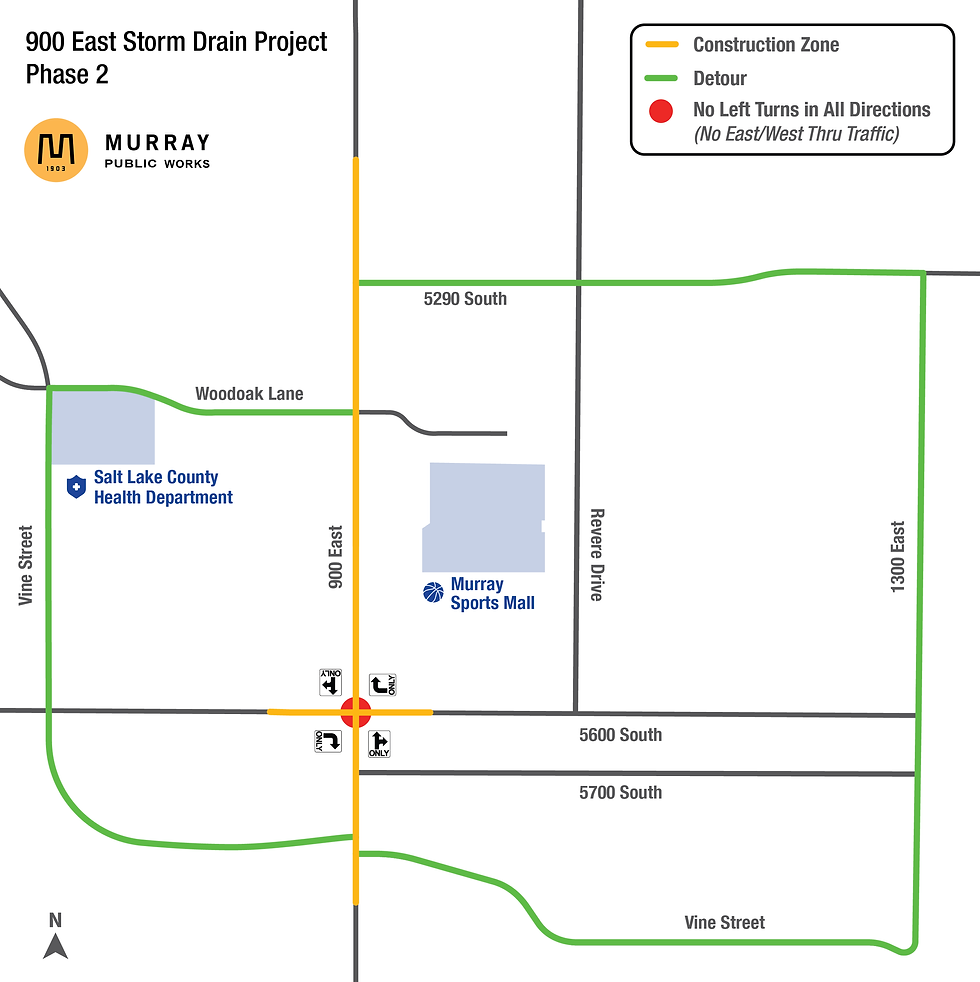
Traffic Pattern - 900 E / 5600 S Intersection:
No left turns are permitted in any direction at the intersection, and east-west through traffic on 5600 South is closed at 900 East for approximately 4 weeks.*
Drivers should use alternate routes and expect delays, and changing traffic patterns throughout the work zone.
Traffic may detour via Woodoak Lane, Vine Street, 5290 South, and 1300 East throughout the duration of the closure. Drivers are encouraged to follow posted detour signage and allow additional travel time.
Business access will be maintained throughout construction.
Ongoing Work
Crews are continuing to install storm drain along 900 East in the middle lanes of the road, heading south toward 5700 South. As crews continue this work, lanes along 900 East will be restricted to one lane in each direction for the duration of the work.
As crews complete storm drain installation, they will begin preparing the roadway for paving, which is anticipated to occur toward the end of the month from Woodoak Lane to just north of the 5600 South intersection.
How the Slide Rail System Works
.jpg)
Crews using the slide rail system to install storm drain pipe along Woodoak Lane.
This project is using a slide rail system to support deep excavation work. The system prevents trench walls and nearby structures from collapsing or caving in by providing stable support.
Crews install posts along the trench and excavate in stages, lowering steel panels between the posts using a dig-and-push method. This creates a safe, controlled work zone as the excavation deepens.
This approach improves safety and efficiency compared to traditional trenching methods and is especially useful for storm drain installation, where maintaining stable soil conditions is critical.